

An exhibition at Adobe Gallery traces Cochiti Pueblo storyteller figures from one family remembrance to a room full of work.
BY BRETT E. TRUSKO
At first, Adobe Gallery feels less like a gallery than a home. The rooms invite a visitor to imagine an object where it might eventually live: on a shelf, a table, or in a place where it can be seen every day. Alexander E. Anthony Jr. says that feeling is intentional. “It looks more like a residence,” he says. The gallery’s rooms on Canyon Road offer a quieter way to encounter work that can be easy to pass over when it is treated as decoration.
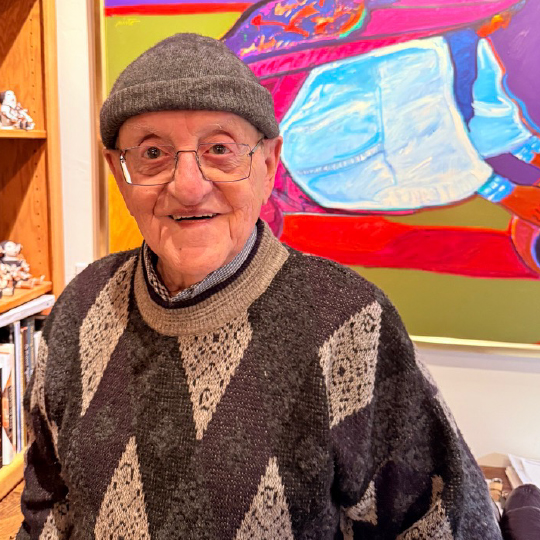
Al came to New Mexico in 1957, newly assigned as a nuclear engineer to a weapons laboratory in Albuquerque. He had grown up in a small North Carolina town and had never seen anything like the architecture, art, and cultures he found in Santa Fe. Within a month, he had bought his first piece of Pueblo pottery: a black, polished bowl by Maria Martinez. At that time he did not yet know who Martinez was. He learned, sought her out, and kept collecting pottery. “I never have been able to stop,” he says.
The business began in 1976 as Pueblo Craft Arts. Two years later, after Al met R.C. Gorman and began selling his work, he changed the name to Adobe Gallery, a broader description of what he hoped the collection could hold. The gallery moved from Albuquerque to its present Canyon Road home in 2001, after Elizabeth McGuardy invited him to see her mother’s guest house. McGuardy’s husband, a general contractor, made the changes that turned it into a gallery. Al stayed for a weekend, fell in love with Santa Fe, and decided to move.
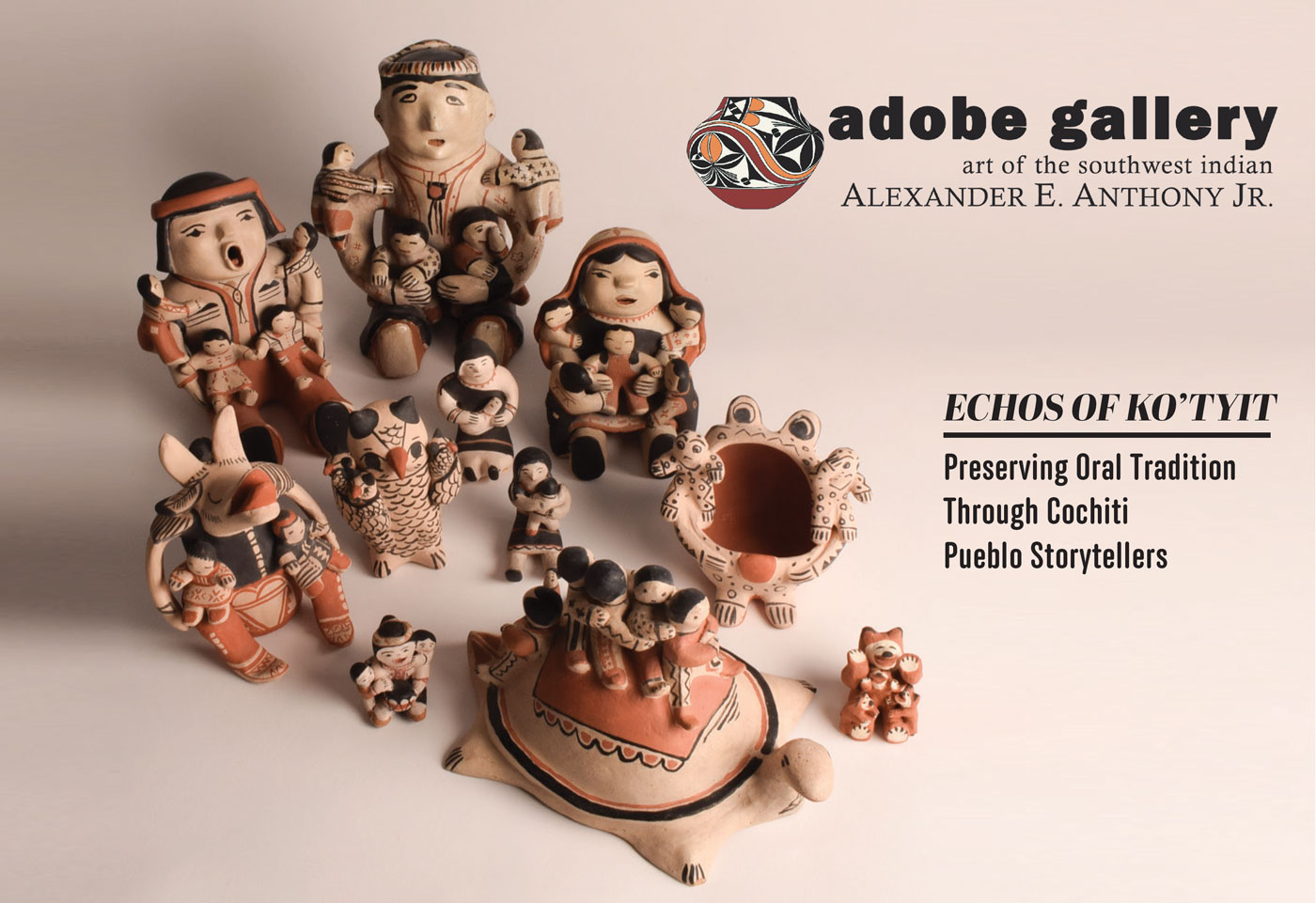
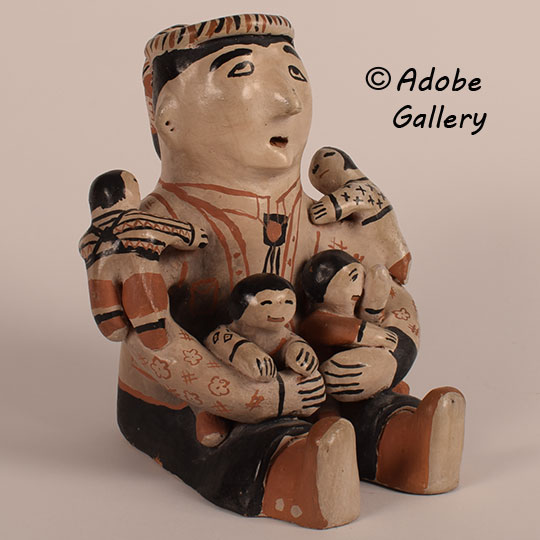
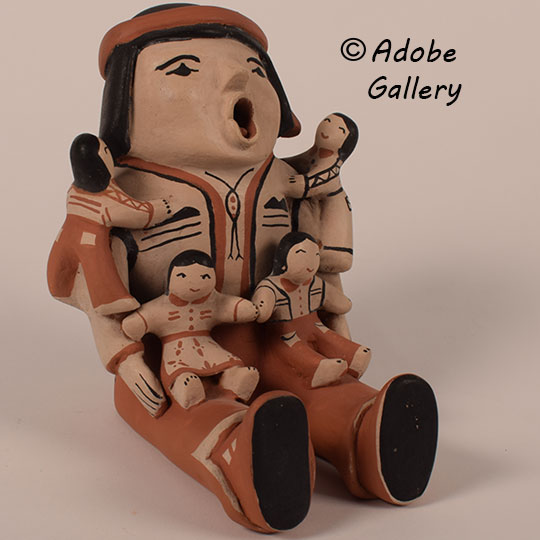
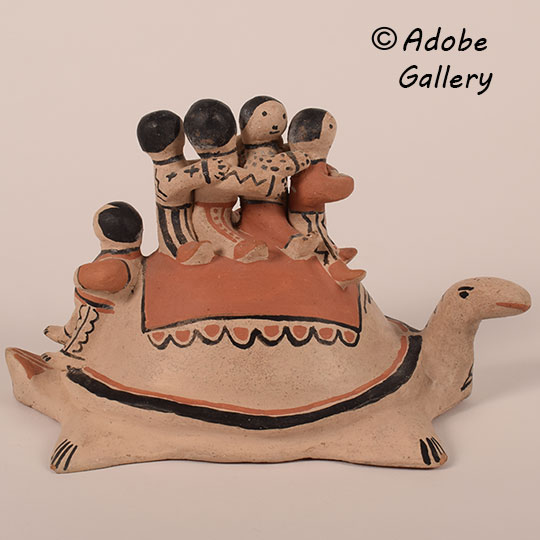
A new exhibition, “Echoes of Ko’tyit: Preserving Oral Tradition Through Cochiti Pueblo Storytellers,” grew from a call by a California client who was downsizing. She had spent years collecting Cochiti Pueblo storyteller figurines and asked whether Al would be interested in them. He said yes. The pieces arrived in boxes; the gallery has been unpacking, photographing, and placing them online as the exhibition has grown. Adobe Gallery’s website lists the exhibition through January 15, 2027.
The figure that anchors the story was made by Helen Cordero in 1964. Al recounts that Cordero had struggled to make pottery vessels to her satisfaction and began shaping small animal figures instead. Folk-art collector and designer Alexander Girard saw her work at Santo Domingo Pueblo and encouraged her to make human figures. Cordero eventually made a seated grandfather—her grandfather— surrounded by children, honoring the storyteller in her own family. Al describes it as the first Cochiti storyteller.
“She was trying to catch a moment,” Al says. “And she did a beautiful job of it.”
The details matter. In Al’s recollection, Cordero’s figures were often large, with children clinging in different ways. The grandfather’s mouth was open, as if speaking, and his eyes were closed. Each child seems to have a separate response: one absorbed, another frightened, another looking away or holding a small animal. The figurine holds a moment rather than a general idea of childhood. “She was trying to catch a moment,” Al says. “And she did a beautiful job of it.”
Al remembers visiting Cordero early in the morning to pick up a figure. She would insist he stay for breakfast before he hurried back to Albuquerque to open the gallery. He recalls her warmth as readily as the work, and that personal history still shapes how he looks at the storytellers. When one of Cordero’s pieces comes into the gallery, he says, it rarely stays long. Her figures have a burnished surface that Al compares to velvet, and a presence he believes came from the family memory behind them.
The exhibition includes works by other Cochiti makers, but Al cautions against assuming that every storyteller follows the same pattern or carries the same intention. Artists vary in scale, finish, and price. He sees Cordero’s work as unusually personal, shaped by her grandfather, while the forms made by later artists respond to different choices and audiences. A visitor does not need to know every detail to begin looking: the posture of the elder, the faces and gestures of the children, the way a group gathers around a voice.
That invitation to look closely sits alongside a sense of responsibility. Al does not think of Pueblo pottery as an accessory for a room. He calls the pieces “national treasures” and asks collectors to understand that ownership also means care. A vessel is not a container for flowers or car keys; a figurine is not simply a charming object. The collector becomes one custodian in a longer passage, enjoying the work and eventually deciding where it should go next.
That passage is visible in the gallery’s calendar. The exhibition of Hopi paintings titled “Ancestral Symbols, Modern Masterpieces” is listed through November 1, 2026, and marks Adobe Gallery’s fiftieth year. On Friday, November 27, the gallery plans a second opening for the Cochiti storyteller exhibition, with a reception from 4 to 6 p.m. and a talk by curator Otillia Engle. Al says the holiday Nacimiento display will return after Thanksgiving, continuing a gallery tradition he dates to 1978.
Other exhibitions are in the works. Al expects about 35 historic pots from a longtime client to return to the gallery in November; he anticipates needing several months to unpack, research, photograph, and list them before a show early next year. He is also planning an exhibition of a dozen or so early Hopi katsina dolls. The dates are not set, but the plans suggest the gallery’s next season will move among pottery, painted histories, and small figures made to be held in the hand or contemplated at home.
For Al, collecting began with a bowl he could barely afford and a place he had not yet learned to navigate. Nearly seven decades later, the work still leads him toward people and stories he did not know when he first arrived. In the storyteller figures, a visitor may recognize the quiet familiarity of children gathered around an elder. The history behind each piece asks for more attention. The home-like rooms give that attention somewhere to settle.
PLAN A VISIT
Echoes of Ko’tyit. On view through January 15, 2027. A reception and curator talk with Otillia Engle are planned for Friday, November 27, 4–6 p.m. Confirm the event time with the gallery before visiting.
Annual Nacimiento exhibition. Al says the gallery’s annual holiday display is expected after Thanksgiving; exact dates were not available at the time of interview.
Adobe Gallery. 221 Canyon Road, Santa Fe. Website lists hours as 10 a.m.–5 p.m., closed Sundays and Wednesdays. adobegallery.com
More info here: Adobe Gallery